A marketing studio that owns your data
Run campaigns, content and analytics on hardware you own, with first-party data that never leaves the building. Compared to HubSpot list pricing.
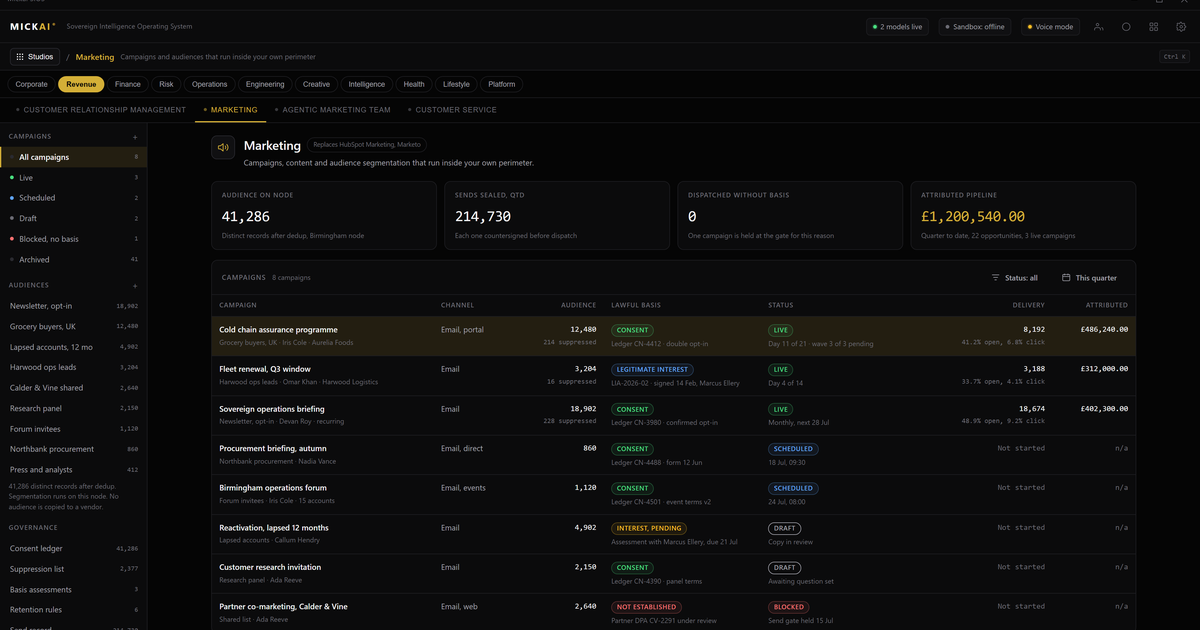
Your marketing data is your most valuable first-party asset, and most marketing platforms hold it for you in their cloud and bill you every year for the privilege. Our marketing studio runs campaigns, content and analytics on hardware you own, with the contact list, the engagement history and the reporting staying in the building. It is one studio on the MICKAI sovereign operating system, not a separate app you have to wire up.
The problem with renting your funnel
Marketing platforms are rented by the year. You pay for a subscription tier, then you pay again for the number of contacts you hold, and the bill grows as your list grows. The list is the thing you built. Every event, every course, every campaign you have ever run added names and behaviour to it. Under the rental model, the more successful your marketing is, the more you pay to keep access to the results of it.
There is a second cost that does not appear on the invoice. Your first-party data lives on someone else's infrastructure. For a regulated firm, that is a standing question every audit, every client review and every data protection assessment has to answer. Where is the list. Who can see it. What leaves the building when a campaign sends.
Our answer is to move the whole thing onto hardware you own and stop the meter.
What the studio actually is
The marketing studio is where campaigns are built and sent, content is drafted and stored, forms and landing pages are hosted, and results are measured. Segmentation, email, automation flows and the reporting that sits on top of them all run inside it. It shares one contact record with the rest of the operating system, so a name in the marketing studio is the same name the CRM sees and the same name the meetings platform sees. There is no sync, no connector to maintain, no nightly job that copies contacts between tools. There is one set of records, on your machine, and the studios read from it.
That single-record design is the point of building on one operating system rather than stitching together separate products. The marketing team, the sales team and the service team are looking at the same first-party data, updated in place, with no vendor sitting in the middle of it.
The assistant runs the work
One assistant spans every studio, including this one. It drafts campaign copy, builds a segment from plain instructions, schedules a send, and reads back the analytics without a specialist having to learn a platform's query language. It works against your own data, on your own hardware, so the material it drafts from and the lists it builds never leave the building to be processed.
We describe the assistant by what it does for the studio, not by what sits underneath it. For a small marketing team, the practical effect is platform capability without platform headcount. You do not need a marketing operations hire to keep the automation running, because the assistant is the operator.
The money, worked conservatively
Compare like for like on the recurring cost. HubSpot Marketing Hub is sold as a published subscription tier, billed annually, with marketing-contact tiers charged on top as your list grows. Those list prices are public and are the ones to use for a fair comparison.
The method matters more than any single figure, because published prices move and contact tiers vary by list size. So build it yourself from the incumbent's own published numbers:
- Take the published annual list price of the Marketing Hub tier you would actually buy.
- Add the published cost of the marketing-contact tier your list size puts you in.
- Multiply that annual total by the number of years you intend to run marketing. Five years is a reasonable planning horizon.
- Hold that recurring total next to owning the studio on hardware you keep.
As a public reference point, HubSpot lists Marketing Hub Professional at a four-figure monthly figure before the contact tiers are added, renewed every year. Whatever your exact tier, the shape of the sum is the same. Rental is a number you pay again next year and the year after, and it rises with your success. Owned hardware is bought once and runs. We do not publish our own price in this article; the comparison you should run is the incumbent's published annual total, multiplied across the years you plan to operate.
State the assumption plainly when you run it: use the vendor's current published list price, assume your real contact tier, and count every renewal year. That is a conservative comparison because it uses the incumbent's own advertised numbers and does not assume a discount you may not get.
First-party data that stays first-party
The studio is air-gapped by default. Campaign build, sending, landing pages, forms and analytics run on your hardware. Your contact records sit in your building. Outbound email leaves through your own mail path when a campaign sends, and the engagement that comes back is written against your own records, locally.
For a regulated firm this changes the answer to the hardest question in any data review. When someone asks where the marketing list is held, the answer is a room you can point at, not a region on a vendor's cloud map. When someone asks what leaves the building, the answer is the campaign itself, and nothing else.
Every action the studio and its assistant take is written to an Open Audit Record at the level of the individual action. Which contact was touched, by which campaign, at what time. That record is yours, on your hardware, and it is there to show a regulator or a client what the system did without asking a vendor for logs.
Not a model to integrate
The important distinction is that this is the whole software stack, not a model you have to build a marketing platform around. You are not buying an intelligence layer and then hiring a team to wrap a product on top of it. You are getting the studio, the shared data layer, the assistant and the audit record as one operating system. The marketing studio is one of 63 studios on it, so the same ownership and the same single record extend to sales, service, finance and the rest of the business as you adopt them.
Private deployment is the baseline everyone in this market now offers. Our value sits beyond it. Action-level auditing, air-gapped operation by default, the complete stack rather than a component, and a design aimed squarely at the regulated small and mid-sized firm that has to own its data but cannot run a platform team.
The company holds 104 filed UK patent applications carrying 2,340 claims across the operating system and its studios. Those are filed applications, not granted rights, and they are not the reason to buy. The reason to buy is that your list, your campaigns and your reporting stop being a subscription you rent and become an asset you own.
What you get, in one line
Campaigns, content and analytics on hardware you own. First-party data that never leaves the building. One assistant across the whole operating system. A recurring bill that stops. Run the incumbent's published annual price across the years you plan to operate, and the comparison makes itself.
Frequently asked questions
Where does our marketing data live?
On hardware you own, inside your building or your own rack. Contact records, campaign history, engagement and analytics stay on the machine. Nothing is copied to a vendor's cloud as a condition of using the software, and the studio runs air-gapped by default.
How does this compare to HubSpot on cost?
HubSpot Marketing Hub is billed as a published subscription tier plus marketing-contact tiers on top, renewed every year. Our marketing studio is one studio on an operating system you buy and run on your own hardware. We do not publish our price here, but the method is simple: take the incumbent's published annual list price, multiply by the years you plan to run it, and compare that recurring total against owning the stack.
Is this only for large enterprises?
No. It is built for the regulated small and mid-sized firm that has to keep first-party data in the building but cannot staff a platform team. One assistant runs the studio, so a small marketing team gets platform capability without platform headcount.
Can we still send email and track engagement without the cloud?
Yes. Campaign build, sending, landing pages, forms, segmentation and analytics all run inside the studio on your hardware. Outbound email goes through your own mail path. Engagement is recorded locally against your own contact records.
What happens to our data if we stop paying?
It stays with you. Because the records and the software sit on hardware you own, there is no vendor switch that locks or deletes your list. There is no export scramble at renewal, because nothing left in the first place.
What proof do we have of what the system did?
Every action the studio and its assistant take is written to an Open Audit Record at the action level. You can show a regulator or a client exactly which contact was touched, by which campaign, and when, from your own logs.