A help desk and support studio you run yourself
Run tickets, replies and knowledge on hardware you own. Our support studio keeps customer data in the building, with the assistant triaging and drafting.
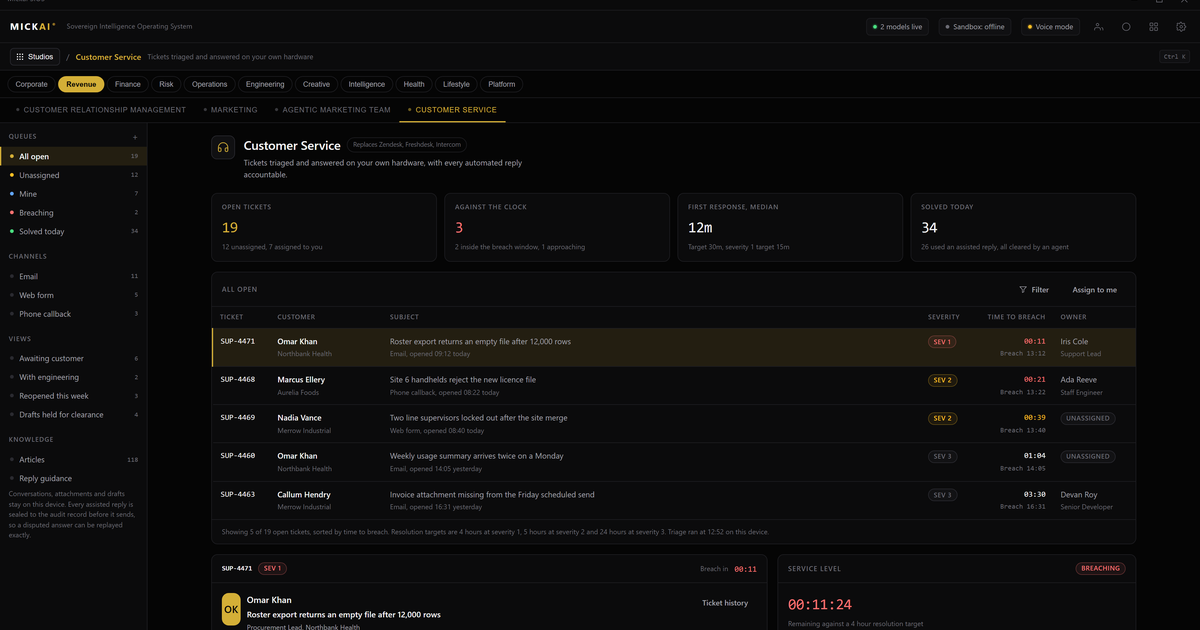
A help desk you run yourself means the tickets, the replies, the contact history and the knowledge base all live on hardware you own, inside your building. Customers still email you, still open tickets, still get answered fast. The difference is that the conversation, and everything the assistant does with it, never leaves your control. You are not renting an agent seat from a vendor who holds your customers' data on your behalf.
This is our support and help desk studio on the MICKAI sovereign operating system. It is not a separate app you bolt on. It is one studio among the platform's 87, sharing the same email system, the same CRM and the same assistant as the rest of your operation. Below is what it does, and what it saves.
What the support studio does
The studio runs a full help desk. Messages arrive by email or through your own channels and become tickets. Each ticket carries the customer's history, the products they hold and the past conversations, because the studio reads from the same records your CRM and email system already keep. There is no separate customer database to reconcile.
Agents work a queue with the usual furniture: statuses, priorities, assignments, tags, SLAs and canned responses. What is different is that the queue, the responses and the knowledge sit on your own machine. A support agent opens a ticket and sees everything, because everything is local.
The knowledge base lives here too. Every resolved ticket, every article your team writes, every product note feeds a knowledge shelf the assistant can draw on. That knowledge is yours. It is not training a vendor's shared model and it is not readable by anyone outside the building.
The assistant that triages and drafts
One assistant runs across every studio on the operating system, and in support it does the work that eats agents' days.
It triages. As a ticket lands, the assistant reads it, tags it, sets a likely priority and routes it to the right queue or person. A billing question goes one way, an outage report another, and an angry customer gets flagged for a human before anything is sent.
It drafts. The assistant writes a first reply grounded in the customer's own history and your knowledge shelf, so the draft is specific rather than generic. An agent reads it, corrects it and sends it, or sends it as is. On simple, well-documented questions that turns a ten-minute reply into a thirty-second review.
It summarises. Long threads collapse into a short brief so an agent picking up a ticket at handover knows the state in seconds.
All of this happens on your hardware. The drafting model does not ship the conversation to an external service to be processed. And because it runs on the sovereign operating system, every action the assistant takes is recorded in the Open Audit Record: what it read, what it tagged, what it drafted, what an agent approved. If a customer or a regulator asks what happened to a piece of their data, you have the answer at the action level, not just a login log.
Customer data that stays in the building
Support is where a company holds some of its most sensitive information. Complaints, account details, health or financial context, the paper trail of a dispute. On a hosted help desk, all of that sits on a vendor's infrastructure, processed under their terms, readable in principle by their systems and their staff.
Private deployment where the vendor cannot see your data is the baseline we start from. Our support studio goes past it. It is air-gapped by default, so nothing leaves unless you decide it should. You connect outbound email and channels on your terms. The customer records, the ticket bodies and the knowledge never need to leave the premises to be useful, because the assistant that works on them runs beside them.
For a regulated small or mid-sized firm, this is the difference between hoping a data processing agreement holds and being able to point at hardware in a room and say the data is here. The heavyweight vendors build for the large enterprise. We build the whole stack for the regulated firm they leave behind.
The cost of renting a support desk
Hosted help desks charge per agent per month. That is the model, and it never stops.
Published list prices vary by product and tier, and you should check the current figure for whichever desk you are comparing, but agent-seat pricing commonly sits in the range of 25 to 90 pounds per agent per month on the mid tiers, with higher tiers well above that. Take a conservative worked example. A support team of 20 agents at a published mid-tier price of 45 pounds per agent per month is:
20 agents times 45 pounds times 12 months, which is 10,800 pounds a year. Every year, rising with each seat you add and each tier you are pushed up. Over five years, at a flat rate and before any increases, that is 54,000 pounds for the right to log in.
That figure buys a seat, not an asset. Stop paying and the desk, the tickets and the knowledge go with it. The assumption here is a single mid-tier price held flat; your real number depends on your headcount, your tier and the add-ons the vendor charges for on top, such as extra channels, analytics or a knowledge base as a separate line.
We do not publish our pricing, and this is not a like-for-like price fight. The point is the shape of the deal. You own the studio and it runs on hardware you own, rather than paying a monthly fee per person for the privilege of using someone else's software and storing your customers' data on their servers.
One operating system, not another app
The reason the support studio is worth more than a standalone help desk is that it is not standalone. It sits on the sovereign operating system alongside the studios for email, CRM, team management, meetings and the rest, 63 studios in total, with one assistant across all of them and one shared set of company data underneath.
So a support ticket already knows the customer from the CRM. A resolved complaint can raise a task in the right team's queue. A pattern of tickets about one product can surface in a management view without anyone exporting a spreadsheet. There is no integration layer to buy and maintain between five vendors, because it is one system. Clients onboard onto a focused set of studios first and grow into the rest.
You are not integrating a model into your business. You are running your business on software you own, on hardware you own, with a record of every action it takes.
Frequently asked questions
Where does our customer data live? On hardware you own. Tickets, replies, contact records and knowledge articles sit inside your building. Nothing is copied to a vendor's cloud to be processed.
Does the assistant read customer messages? Yes, locally. It triages, tags and drafts replies on your own machine. The drafting model never sends the conversation off site, and every action it takes is recorded.
Can it run without an internet connection? Yes. The support studio is air-gapped by default and works offline. You choose whether email and channels connect out, and what leaves the building.
How does this compare to a hosted help desk subscription? Hosted desks charge per agent per month, every month. Published agent-seat prices commonly sit around 25 to 90 pounds per agent per month. You own the studio instead of renting a seat.
Is it just the help desk, or the whole stack? The whole stack. Support is one of 63 studios on one sovereign operating system, sharing your email, CRM and knowledge through a single assistant. Clients start on a focused set.
What can you audit? Every action, not just logins. The Open Audit Record captures what the assistant read, what it drafted and what an agent sent, so you can answer a regulator or a customer with a record.
Frequently asked questions
Where does our customer data live?
On hardware you own. Tickets, replies, contact records and knowledge articles sit inside your building. Nothing is copied to a vendor's cloud to be processed.
Does the assistant read customer messages?
Yes, locally. It triages, tags and drafts replies on your own machine. The drafting model never sends the conversation off site, and every action it takes is recorded.
Can it run without an internet connection?
Yes. The support studio is air-gapped by default and works offline. You choose whether email and channels connect out, and what leaves the building.
How does this compare to a hosted help desk subscription?
Hosted desks charge per agent per month, every month. Published agent-seat prices commonly sit around 25 to 90 pounds per agent per month. You own the studio instead of renting a seat.
Is it just the help desk, or the whole stack?
The whole stack. Support is one of 63 studios on one sovereign operating system, sharing your email, CRM and knowledge through a single assistant. Clients start on a focused set.
What can you audit?
Every action, not just logins. The Open Audit Record captures what the assistant read, what it drafted and what an agent sent, so you can answer a regulator or a customer with a record.