The Five-Hundred-Million-Dollar Lesson and the Sovereign Answer
One enterprise ran up a half-billion-dollar Claude bill in a single month. Microsoft throttled internal Claude Code licences. Uber's 2026 AI budget was exhausted by April. The cash cost was the headline. The data cost was the structural disqualification. The Mickai operating system is the freehold answer to both, deployed on hardware the operator sources and owns, signed under FIPS 204, with no subscription for context or usage, ever.
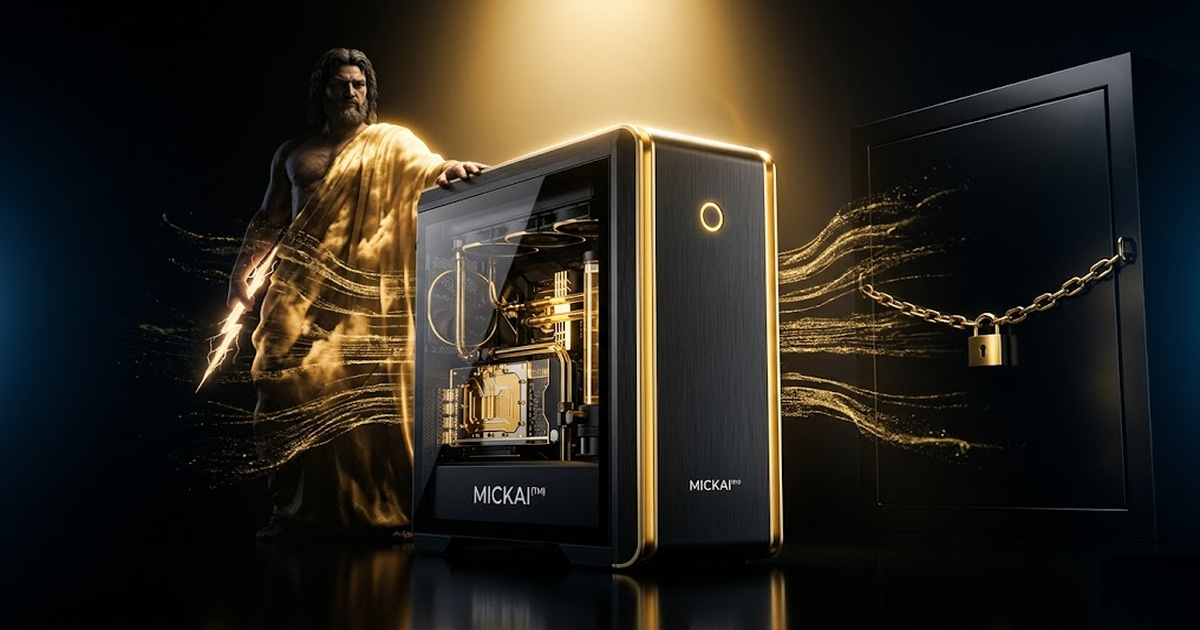
Three numbers landed in the same week and refused to be read in isolation. A single enterprise reportedly ran up a five-hundred-million-dollar Claude bill in one calendar month. Microsoft moved to throttle internal Claude Code licences after monthly per-engineer costs climbed into the high hundreds and thousands of dollars. Uber's 2026 AI budget, by separate reporting, was exhausted by April. On the developer side, a thread in the r/ClaudeCode community on Reddit at reddit.com/r/ClaudeCode/s/DzTsNI5yA3 captured what working programmers were already saying out loud, that the price of doing real engineering work through a hosted subscription is climbing faster than the wages of the engineers using it.
Read together, the three numbers describe a single trend. Frontier-class inference costs money to serve. The standard subscription model is a polite fiction that hides that cost behind a flat monthly figure with very little relation to what the model actually consumes when it runs. The fiction held while the labs were willing to subsidise the gap. It will not hold forever.
But the cash cost was the headline. The cash cost was not the part of the story that should keep a regulated buyer or a sovereign department awake at night. The cash cost was the meter. The meter is recoverable. A subscription you cannot afford can be cancelled. A budget that runs out can be replenished or rationed.
There was a second invoice that was not in any of the headline numbers, and it was the one that mattered most.
The hidden second invoice, the data cost
The five-hundred-million-dollar month was a month in which every prompt, every document, every line of code, every confidential email, every customer record, every internal strategy memo, every legal draft, every clinical note, and every piece of acquisition intelligence the enterprise sent to the model went over the wire to a foreign endpoint, was retained for an unspecified period under the vendor's policies, sat on infrastructure not under operator control, and could be subpoenaed, breached, accessed by an insider, or surrendered to a foreign government request, none of which the enterprise could prevent and most of which it could not even detect.
That is not hyperbole. It is the structural condition of the cloud-AI arrangement. The operator hands the work to the vendor. The vendor processes the work. The work is then in a system the operator does not own. The operator's only recourse if anything goes wrong is the vendor's contractual goodwill, which is a thinner instrument than most regulated buyers think it is.
For a regulated industry, this is structural disqualification. Production data from a national defence contractor, a clinical research programme, a financial institution under the Prudential Regulation Authority, a sovereign-wealth allocator, or a critical-national-infrastructure operator cannot lawfully leave the operator's perimeter into a foreign-hosted model with retention policies the operator does not write.
For a household, it is gradual surveillance. The chat subscription that started at twenty pounds a month becomes a record of every personal question, every domestic worry, every health concern, every relationship problem, every financial decision, all sitting in the vendor's data store under the vendor's retention policy, accessible to whoever the vendor permits.
For a sovereign government, it is a category-7 risk. National material on a foreign-hosted model is not a risk a national-security accreditor will accept. The accreditor will not write the certificate.
The five-hundred-million-dollar month invoiced one cost. It quietly invoiced a much larger second cost. That second cost is what made the headline matter.
The subscription is being scrapped, and the meter that replaces it is worse
A serious buyer should be reading the five-hundred-million-dollar month not as a one-off accident but as a preview of where the cloud-AI vendor's pricing is going next. The subscription model was always the marketing layer over the underlying inference cost. It existed to capture the household and the small operator at a flat monthly figure the lab could absorb during a phase of capital-funded growth. That phase is ending.
The labs have two arithmetic-permissible futures from here. They are both worse than the present.
The first is to tighten the subscription. Microsoft's per-engineer throttle on internal Claude Code licences is this. Anthropic's introduction of weekly Sonnet caps inside the Claude Code tier is this. Both are the same move, the same constriction. The flat-fee tier survives as a brand, but the work the operator can do inside it shrinks every quarter. The household that paid twenty pounds a month for everything moves to thirty pounds a month for less. The small operator that ran an entire workflow on a single tier finds that tier covers only the first week of the month.
The second is to drop the subscription model entirely and price the underlying inference at its true marginal cost through a metered application programming interface. This is the future that the trade press has been quietly trailing in the past six months. The argument is rational. The marginal cost of one more token of frontier-class inference is real money, paid by the lab to keep the cluster alive. A flat-fee subscription is a structural mismatch with that economics. A metered API is honest, the argument goes.
Honest, perhaps. Affordable, no. The five-hundred-million-dollar month was the metered API in action at the scale a real enterprise actually consumes inference. The enterprise was not malicious. The enterprise was not careless beyond the missing usage cap. The enterprise was simply running a normal engineering organisation against a normal model API at a normal usage profile. The bill that arrived was the bill the meter generated.
Scale that bill to where serious cloud-AI consumption is heading. A research department of fifty engineers, each consuming ten million tokens a day at five dollars per million tokens, is twenty-five thousand dollars a day, seven hundred and fifty thousand dollars a month, for one team. An enterprise with ten such teams is seven and a half million dollars a month for one division. An enterprise with ten such divisions, which is the size of a regulated bank or a national defence supplier, is seventy-five million dollars a month, nine hundred million dollars a year, for the AI line item alone, before the team has done anything genuinely token-heavy like multi-step agentic work, long-context reasoning, or large document processing. The five-hundred-million-dollar month was not the outlier. It was the early signal of where every cloud-AI consuming enterprise is being pushed.
The household end of this transition is the harder problem, not the easier one. A household forced off a flat-fee subscription tier into metered access through a credit card on file is structurally worse off. The subscription, broken though its economics are, at least caps the worst-case bill at the subscription price. The credit card on file caps the bill at the credit limit. The household that fell asleep with a runaway agent open on the laptop discovers in the morning that the credit card has been charged for the agent's overnight curiosity. The headlines about household credit-card bills from runaway agent loops have already started.
In the metered future, there is no flat-fee tier to protect anybody. There is the credit card, the meter, and whatever cap the operator remembered to set in the dashboard. The five-hundred-million-dollar month is the enterprise edition of the same failure mode the household edition is about to produce at smaller scale, more often, on people who can afford it less.
This is what gives the freehold its urgency. The freehold is the only pricing shape that survives the transition, because the freehold does not have a meter. The operator pays once for the hardware. The inference happens on the hardware. There is no per-token bill at any scale. The household with a Castor on the desk does not have to remember to set a cap before going to bed. The enterprise with a Prometheus in the rack does not generate a five-hundred-million-dollar invoice because there is no invoice to generate.
The operator who buys the freehold today buys protection from the meter that is about to arrive. The operator who waits for the meter to arrive first pays the meter at the rate the lab sets on the day.
What audit trail does the cloud vendor produce?
Ask the vendor for a cryptographically signed audit trail of every decision the model made on the operator's behalf, replayable independently by the operator's regulator, verifiable without the vendor's cooperation, with the operator's key as the signing root. The vendor cannot produce one. The vendor cannot produce one because the cryptographic primitive is not in the substrate.
The vendor can produce server logs. The vendor can produce billing records. The vendor can produce sanitised metrics. The vendor cannot produce a signed causal directed acyclic graph of every decision, written at commit time, replayable by a verifier the operator runs, against a policy that was in force at the time, under a key the operator holds. That is what a sovereign audit trail looks like. The cloud vendor's substrate cannot carry one.
This is the audit-trail problem that the Mickai substrate was designed to solve. Every action the Mickai Sovereign Intelligence Operating System takes is written to the Open Audit Record, signed at commit time under FIPS 204 ML-DSA-65, walkable end to end by an offline verifier, replayable against the policy that was in force when the action committed. The vendor cannot edit history because the vendor does not have the key. The operator can prove what the system did. The regulator can verify what the operator proves.
That is the substrate change the moment requires. The cloud-AI arrangement cannot supply it. The Mickai substrate can, and is on the public record at the UK Intellectual Property Office.
The sovereignty answer in one sentence
What replaces the cloud-AI subscription is the same thing that replaced every other piece of computing that became load-bearing enough to justify the move. The operator owns the hardware. The Sovereign Intelligence Operating System is preinstalled. The cooperative of brains runs locally. The audit record is signed in place. There is no subscription for context. There is no subscription for usage. The price you pay on day one is the price you pay for life.
It is a freehold arrangement to replace a leasehold. The same shift that took mainframes to workstations, and workstations to laptops, and hosted services to self-hosted alternatives wherever the workload was load-bearing enough to justify it. Generative AI is now load-bearing enough.
The Mickai SIOS, what it is
Mickai is a Sovereign Intelligence Operating System, not an application and not a programme. It is the substrate beneath the work. It runs frontier-class artificial intelligence entirely on hardware the operator controls, under keys the operator holds, with a complete and cryptographically verifiable record of everything the system does. It is held privately by its founder, Micky Irons, the named inventor on a patent corpus of one hundred and four filed UK applications with two thousand three hundred and forty claims across them, on the public UK IPO register under GB2607309.8 onwards.
The SIOS layer carries:
A cooperative of fifty brains. Twenty-five domain specialists, arranged in five subsystems. PALANTIR runs strategic reasoning. SENTINEL holds the security perimeter. GABRIEL drafts and seals every outbound message. ZEUS reads law and case law against proposed actions. MICHAEL handles doctrine and clearance-gated material for defence operators. ATHENA asks whether a thing should be done before the system does it. ATLAS reasons about borders and jurisdictions. PHOENIX runs clinical reasoning. MAXIMUS handles training periodisation and biomechanics. SALVATOR runs humanitarian triage. KARP produces signed analytical reports. JAXON writes code. RAIDEN runs real-time signal pipelines. QUANTUM produces proof-carrying derivations. And the rest of the twenty-five domain specialists, each with a domain, a knowledge base, and a tooling stack catalogued, signed, and shipped, completed by twenty-five operational brains (the eight-brain Chronus Kernel cognitive core, the two Custodians (MNEMOSYNE and AESCULAPIUS), and the fifteen Specialists), all running on the Poseidon silicon substrate, which is not one of the fifty.
Each of the fifty brains is a Mickai model. Today they run on our own specialised models that Mickai hardens on the sovereign sealed corpus every signed interaction forms, and Mickai is already training toward weights that are ever more native. The funded roadmap scales that work into fully Mickai-native weights at frontier scale, massively accelerated by the raise.
The Chronus orchestration kernel beneath them. Arbiter routes requests. Router decomposes them into a directed acyclic graph across the cooperative. Planning produces dry-run simulations before high-impact actions commit. Policy compiles and enforces the governance contract. Audit Ledger maintains the post-quantum signed causal DAG of every decision. Identity binds every action to a hardware-attested operator key. Permissions descends to the cell level. Quorum convenes multi-brain agreement on high-stakes actions.
The Open Audit Record substrate. Every action signed under FIPS 204 ML-DSA-65, the post-quantum lattice signature scheme published by NIST in August 2024 and adopted by the SIOS as the canonical bind between an operator's identity and a committed action. The choice of a post-quantum primitive is deliberate; audit records produced today will need to be verifiable in twenty years.
The clearance-gated retrieval primitive. Role-based access enforced in the substrate, not requested in a policy document. The audit ledger records every check.
The host-acceptance attestation that lets a Mickai bundle migrate from one machine to another without breaking its signed chain.
That is the work the SIOS does. The cloud-AI vendor cannot do it because the substrate is not theirs to change. The Mickai patents cover the primitives.
The hardware lineup, all built in Britain
The Mickai workstation lineup runs from the Castor mini PC up through the Prometheus edge server to the Pantheon data-centre system, alongside the HELIOS energy-sovereign family. Every one is built in Britain by our manufacturing partner in Birmingham, England. Every one ships with the SIOS preinstalled, the cooperative of brains, the Open Audit Record, the sandboxed upgrade channel, and the same freehold pricing contract. What changes between them is the form factor and the load they carry.
Castor is the sixty-four-gigabyte mini PC. A one-litre obsidian aluminium chassis, an NVIDIA RTX 4060 mobile class GPU at eight gigabytes of VRAM, an AMD Ryzen 9 at eight cores, sixty-four gigabytes of DDR5, two terabytes of NVMe Gen 5. For the small office desk, the single-monitor freehold, the operator who wants the SIOS on the box without a tower next to the desk. Castor was the mortal twin of the Dioscuri in Greek myth, brother to Pollux. Mickai uses the name for the mortal half of the paired set.
Pollux is the one-hundred-and-twenty-eight-gigabyte mini PC. The divine twin, sold alongside Castor where it makes sense. A two-litre chassis, twelve gigabytes of VRAM on an RTX 4070 mobile class GPU, a sixteen-core Ryzen 9, four terabytes of NVMe. For the office that wants the full SIOS, the Agentic Marketing Team running marketing in the background, agentic workflows at small-team scale.
Daedalus is the sixteen-inch laptop. A three-thousand-pixel OLED at one hundred and twenty hertz with full DCI-P3 coverage, sixty-four gigabytes of DDR5, an NVIDIA RTX 5070 or 5080 mobile GPU, four terabytes of NVMe, ninety-watt-hour battery for around fourteen hours of productive use. For designers, CAD operators, architects, travelling founders, and the operator who needs the SIOS on the move. Daedalus was the master craftsman of Greek myth, the one who built the Labyrinth and the wings.
Icarus is the fourteen-inch ultraportable. A three-thousand-pixel OLED, thirty-two gigabytes of DDR5, an NVIDIA RTX 5060 or 5070 mobile GPU, two to four terabytes of NVMe, a one-hundred-watt-hour battery for around eighteen hours, 1.3-kilogram class. The son of Daedalus in Greek myth, the youth who flew with wings of feathers and wax. For students, travelling consultants, on-site engineers, and the operator who needs the SIOS in the carry-on.
Hermes is the entry workstation. A twenty-four-core AMD Threadripper PRO, a single NVIDIA RTX PRO 6000 Blackwell with ninety-six gigabytes of GDDR7 or an RTX 5090 at thirty-two gigabytes, two hundred and fifty-six gigabytes of DDR5 ECC, eight terabytes of NVMe, ten-gigabit Ethernet. For the founder, the academic, the consultant who needs frontier AI on the desk without a recurring bill. Hermes was the messenger of the gods, the swift one.
Hyperion is the mid workstation. A ninety-six-core Threadripper PRO, two RTX PRO 6000 Blackwell GPUs with one hundred and ninety-two gigabytes of GDDR7 across them or a single NVIDIA H200 NVL at one hundred and forty-one gigabytes of HBM, five hundred and twelve gigabytes of DDR5 ECC, sixteen terabytes of NVMe plus a thirty-two-terabyte SSD pool, twenty-five-gigabit Ethernet, an optional hardware timestamping NIC. For small teams, regulated industries, agentic-heavy workloads. Hyperion was the Titan of light, the watcher from on high.
Olympus is the flagship workstation, the Frontier tier, the Mickai Trading Bot machine. Dual AMD EPYC 9965 at one hundred and ninety-two cores total, four NVIDIA Blackwell Ultra B300 NVL GPUs with NVLink at around one-point-one-five terabytes of HBM3e in aggregate, two terabytes of DDR5 ECC, thirty-two terabytes of NVMe plus a fifty-terabyte SSD redundant pool, two hundred gigabits per second of InfiniBand or Mellanox ConnectX-7 with kernel-bypass DPDK, optional FPGA line-rate signing of the Open Audit Record. Under ten milliseconds end-to-end from market signal in to quorum-checked, OAR-signed decision out, for the Mickai Trading Bot. For trading desks, market-data pipelines, defence and intelligence workflows where milliseconds decide. Olympus is the mountain of the gods.
Prometheus is the four-U rack-mount enterprise edge server. Four AMD EPYC 9965 at seven hundred and sixty-eight cores total, eight Blackwell Ultra B300 NVL GPUs in HGX configuration at around two-point-three terabytes of HBM3e, four terabytes of DDR5 ECC scalable to six, one hundred terabytes of NVMe Gen 5 plus a multi-tier SSD pool, dual four-hundred-gigabit Ethernet with kernel-bypass DPDK, redundant power, redundant cooling, hot-swap everything. Five-trillion-parameter inference on-prem, signed audit at line rate, the Mickai cooperative running for hundreds of operators at organisational scale. Prometheus brought fire to humanity in Greek myth, the first transfer of intelligence from the gods to the people.
Pantheon sits above Prometheus as the data-centre system, a multi-node rack-scale build for sovereign data centres that run the SIOS across many racks under one operator-held audit chain, where a single edge server is no longer enough. It carries the same Open Audit Record signing, the same clearance gates, and the same operator-held keys as every other SKU, scaled to data-centre footprint. Pantheon was the temple to all the gods, the house that holds the whole pantheon at once.
Beyond the compute family sits the HELIOS family, the energy-sovereign line named after the Greek sun, off-grid and solar-aware, built to run the same brains within a harvested-energy envelope where the grid cannot be assumed.
Every SKU ships at brand-card standard: brushed obsidian aluminium chassis, satin gold trim, gold-ring LED on the power button, brushed gold mesh on the intake vents, real ports across the front panel, the MICKAI(TM) wordmark etched into the chassis, no other branding at launch.
The full lineup, the compute family from Castor to Pantheon plus the HELIOS energy-sovereign family, with photographs, named-after notes, and full spec sheets, sits at mickai.co.uk/hardware.
The Build Your Own configurator
The lineup described here is a direction, not a current catalogue. Mickai does not manufacture hardware today: the SIOS runs on hardware the operator sources from their own supplier, sized to the workload against a specification we help confirm. A use-case-first configurator for a Mickai-built lineup, picking the SKU and starting build by workload, is on the roadmap rather than live.
Once a Mickai-built lineup exists, the intent is for a configurator to expose adjustable modules per SKU: CPU, GPU (RTX 5060 mobile to Blackwell Ultra B300 NVL), RAM (thirty-two gigabytes to six terabytes), storage, network (Wi-Fi 7 to four-hundred-gigabit Ethernet), operating system (Mickai SIOS on hardened Linux, on Windows 11 Pro, or dual boot), and add-ons including the Poseidon Sovereign AI SoC and an FPGA for line-rate Open Audit Record signing. Today, request a briefing and we size a supplier-sourced configuration against your actual use case instead.
What the operator can actually do
For each SKU the operator can see, on the detail page, a capabilities matrix. Concrete software, concrete levels.
A Castor desktop runs Photoshop at four-thousand-pixel resolution, Figma at full project scale, DaVinci Resolve at one-thousand-and-eighty-pixel editing, VS Code with the Mickai vibe-code brain helping on small to medium projects, and the SIOS at conversational latency.
A Pollux office runs the Agentic Marketing Team in the background, Photoshop at eight-thousand-pixel resolution, four-thousand-pixel video edit in DaVinci Resolve, multi-language agentic coding across small repos, and the AMT marketing campaigns end to end.
A Daedalus laptop runs Revit, ArchiCAD, SolidWorks, Rhino, SketchUp Pro on real architectural project trees, DaVinci Resolve at four-thousand-pixel grading on the move, full IDE agentic coding across mid-to-large repos, and the SIOS portable.
An Icarus ultraportable runs Figma, Affinity, Adobe Illustrator at full project scale, one-thousand-and-eighty-pixel video edit, single-language IDE work on small to medium projects, the SIOS at university and travel scale.
A Hermes workstation runs Photoshop at any resolution, Blender, Cinema 4D, Maya at full project scale, architectural visualisation in Lumion or Twinmotion at studio scenes, Revit and ArchiCAD on city-block projects, DaVinci Resolve at eight-thousand-pixel mastering, full agentic coding across large repos.
A Hyperion workstation runs full studio-scale three-dimensional rendering, real-time ray tracing in Unreal Engine at city scale, large enterprise BIM, virtual production at scale, full team agentic coding with multiple concurrent agents per developer, and the SIOS at team load.
An Olympus flagship runs frontier-class generative design, real-time eight-thousand-pixel colour grading at film scale, virtual production at cinematic productions, AI-generated video at the largest model size, multi-agent fleets running an entire engineering organisation, and the Mickai Trading Bot at under ten millisecond signed envelope.
A Prometheus edge server hosts the SIOS at organisational scale, five-trillion-parameter inference on-prem, render-farm-class workloads for studio post-production, AI-assisted engineering organisation-wide, and the Trading Bot at enterprise scale.
The capabilities matrix is on every SKU detail page. The buyer can see, before they commit, exactly what their chosen build will do.
The patent corpus, the substrate underneath
Mickai is held privately by its founder. The substrate is on the public UK IPO register under GB2607309.8 onwards, and the corpus is one hundred and four filed applications with two thousand three hundred and forty claims across them. The applications cover the multi-brain cooperative architecture, the Open Audit Record, the FIPS 204 ML-DSA-65 signing primitive, the clearance-gated retrieval, the AudioSeal dual-layer watermark, the silicon root of trust, the host-acceptance attestation that lets a Mickai bundle migrate from one machine to another without breaking its signed chain, and the rest of the primitives underneath.
The applications are filed, building toward examination and grant. The architecture is invented, on the public record, and is the substrate every SKU in the lineup carries.
A cloud-AI vendor cannot copy the substrate without first reading the corpus. The corpus exists, and is public, and is named.
Poseidon, the Mickai in-house silicon
Mickai is also building its own silicon. Poseidon, the Mickai Sovereign AI SoC, is the in-house chip that complements the NVIDIA GPU fabric on every Mickai workstation. The role of Poseidon on the chassis:
It carries the Open Audit Record signing primitive in silicon, so every action can be signed at line rate even on lower SKUs that do not carry an FPGA. It holds the hardware identity and the cryptographic root of trust for the operator. It sits between the network interface and the GPU fabric so every action that crosses the bus can be policy-checked before commit.
Poseidon is in the patent corpus already. It is an add-on on every SKU as the silicon lands, and it does not replace the NVIDIA fabric. It sits beside it, holding the audit and identity primitives that the SIOS needs to be sovereign.
Why NVIDIA Blackwell, the fabric beneath the work
The Mickai inference fabric runs on NVIDIA Blackwell silicon. The Blackwell Ultra B300 carries two hundred and eighty-eight gigabytes of HBM3e per GPU, twenty thousand four hundred and eighty CUDA cores, fifteen petaflops of dense floating-point-4 compute, PCIe 6.0 host connectivity, and NVLink 5 at fifty gigabytes per second per direction across eighteen connections per GPU. The RTX PRO 6000 Blackwell Workstation Edition carries ninety-six gigabytes of GDDR7, twenty-four thousand sixty-four CUDA cores, fifth-generation Tensor Cores, six hundred watts maximum draw, and PCIe 5.0 x16.
These are the right pieces of silicon for the load the cooperative of brains demands. Mickai builds on them because they are the best available. NVIDIA, Blackwell, RTX, and CUDA are trademarks of NVIDIA Corporation, used by Mickai for product reference and accreditation. Mickai is not a formal NVIDIA Partner Network partner at the time of writing, and we name the components but do not display the marque on the chassis until accreditation lands.
The fabric is the floor. The cooperative, the SIOS, the audit substrate, and the Poseidon SoC are the work.
The freehold contract, pricing for life
The most important pricing commitment is that the price of the Mickai workstation, on the day the operator buys it, is the price forever. There is no plan migration. There is no retroactive tier change. There is no quiet shift to a new edition that costs more. There is no clawback if you use the machine harder than expected. There is no premium that activates when a new model becomes available. There is no service tier that decides whether your old machine is still allowed to do its job.
Upgrades are optional, paid, and applied through the sandboxed channel. The dry-run primitive that lives in the Planning brain runs on every upgrade so the operator can see what changes before the changes commit. Upgrades are not required for the machine to keep doing its job. An operator who decides never to apply another upgrade keeps a fully functioning workstation forever, on the capabilities they bought on day one.
This is the inversion of the standard cloud arrangement. In the cloud arrangement, capabilities can be revoked at the vendor's discretion and the meter runs whether the operator is awake or asleep. On the Mickai workstation, capabilities belong to the operator and the only running expense is the electricity the machine draws.
Who this is for
Four constituencies sit at the front of the queue.
The founder. A Mickai workstation replaces a stack of vendor accounts that each charge a recurring fee. The Agentic Marketing Team replaces what would otherwise be six retainers and three subscriptions. The Trading Bot replaces an outsourced wealth manager taking percentage points off the operator's capital. The cooperative of brains replaces a stack of vendor subscriptions for legal, clinical, code, research, and design work.
The regulated industry. Law firms, accountancy practices, insurance underwriters, clinical providers, financial institutions under the Prudential Regulation Authority, GSK and the pharmaceutical sector, the National Health Service, and every UK regulated workstation share a single problem, that the audit trail is part of the deliverable, and the audit trail being held by someone else is part of the problem. The Mickai workstation ends that problem because the audit trail belongs to the operator. Every brain produces signed artefacts. Every action is sealed under FIPS 204 ML-DSA-65. Every policy decision is replayable. The regulator can verify what was done without asking the vendor to provide a redacted statement after the fact.
The sovereign government. Departments that work on classified material, security services, defence operators, and national-infrastructure providers cannot use a cloud subscription whose meter is held by a foreign company. The Mickai workstation runs every model on-device, signs every action under operator keys, and refuses, by construction, to transmit operator material to an external endpoint. The clearance-gated retrieval primitive ensures that classified material is only ever visible to operators with the appropriate ceiling.
The household and the single-person operator. The freelance designer who built a workflow around a hosted model. The independent developer with a side project on an API. The student who used the long-context model to read alongside them. The carer using the assistant to manage a parent's medication. The small charity. The teacher. The retired engineer. For each of them, the meter has already arrived or is about to. The Mickai workstation, paid for once, gives them the same capability without the meter, forever.
What happens next
The Mickai operating system is live today, deployed on hardware the operator sources from their own supplier; see mickai.co.uk/hardware for how to start a deployment. A Mickai-built hardware lineup, the eight SKUs described above, is on the roadmap rather than available to order, with no SKU, configurator, or pre-order flow live yet.
Pricing is to be disclosed at launch. The freehold contract is fixed: no subscription for context, no subscription for usage, paid upgrades through the sandboxed channel only, optional, price for life.
The leasehold era ends, the freehold era begins
The cloud era of AI was a leasehold. The operator rented capability that lived in someone else's building, accessed it through someone else's authentication, paid through someone else's meter, and watched the bill arrive at the end of every month with whatever increase the landlord had decided. The leasehold worked while the landlord was willing to subsidise the rent. It does not work now that the subsidies are tightening. The five-hundred-million-dollar month was the moment the subsidy ended on the public balance sheet.
What replaces it is a freehold. The operator owns the building. The operator holds the keys. The audit log lives on the operator's premises. The capability cannot be revoked by an external party because the external party has nothing to revoke. The price is the price the operator paid on the day, and it does not change because someone adjusted a pricing page on a website. The data does not leave the operator's perimeter, because the work happens on the operator's machine. The audit trail is the operator's, not the vendor's, because the signing key is the operator's.
The household that has been counting the cost of a subscription that keeps changing should stop counting and start owning. The founder forced into a tier upgrade every quarter to keep the same workflow alive should stop renewing and start owning. The regulated firm asked to trust someone else's audit log should stop trusting and start owning. The sovereign department told to put national material into a foreign meter should stop transmitting and start owning. The freehold is the answer. The Mickai workstation is the form the freehold takes. The leasehold era ends here.
Sources
- Axios, 28 May 2026. The original report of an unnamed enterprise running up roughly five hundred million dollars on Claude in one month, sourced to an AI consultant. axios.com.
- Tom's Hardware. "Mystery company accidentally blew \$500 million on Claude AI in a single month, failed to put usage limit on licenses for employees." tomshardware.com.
- Tech Startups. "Company accidentally spent \$500 million on Claude AI in one month after forgetting usage limits." techstartups.com.
- Crypto Briefing. "Client loses \$500M on Claude due to uncapped AI usage." cryptobriefing.com.
- BeInCrypto. "Client Accidentally Burns \$500 Million on Claude AI in One Month." beincrypto.com.
- Yellow. "Claude Spending Tops \$500M When One Client Forgot Usage Limits." yellow.com.
- The r/ClaudeCode community discussion of weekly Sonnet caps and tier-upgrade pressure. reddit.com/r/ClaudeCode.
- Microsoft internal Claude Code licence caps, reported alongside the above, with monthly per-engineer costs cited between five hundred and two thousand dollars.
- Uber's 2026 AI budget reportedly exhausted by April, covered across the same trade press.
- NVIDIA GB300 NVL72 product page. nvidia.com/en-us/data-center/gb300-nvl72/.
- NVIDIA RTX PRO 6000 Blackwell Workstation Edition product page. nvidia.com/en-us/products/workstations/professional-desktop-gpus/rtx-pro-6000/.
- NIST FIPS 204 ML-DSA-65 specification. csrc.nist.gov/pubs/fips/204/final.
- The Mickai Sovereign Intelligence Operating System patent corpus on the UK IPO public register. GB2607309.8 to GB2611925.5, named inventor Mickarle Wagstaff-Irons, one hundred and four filed applications, two thousand three hundred and forty claims. ipo.gov.uk.
- The Mickai hardware page, deployment on supplier-sourced hardware today and the Mickai-built hardware roadmap. mickai.co.uk/hardware.
- The Mickai partners and upstream components page. mickai.co.uk/partners.
NVIDIA, Blackwell, RTX, NVLink, and CUDA are trademarks of NVIDIA Corporation. Microsoft, Windows, and Claude are trademarks of Microsoft Corporation and Anthropic PBC respectively. Linux is a registered trademark of Linus Torvalds. AMD, Threadripper, EPYC, and Ryzen are trademarks of Advanced Micro Devices, Inc. Intel, Xeon, and Core Ultra are trademarks of Intel Corporation. All other product names and trademarks are the property of their respective owners and are used for product reference and accreditation only.