The Mickai substrate corpus is now on the public timestamped record. Fifteen engineering ebooks, five independent repositories, one fixed and independently verifiable disclosure date.
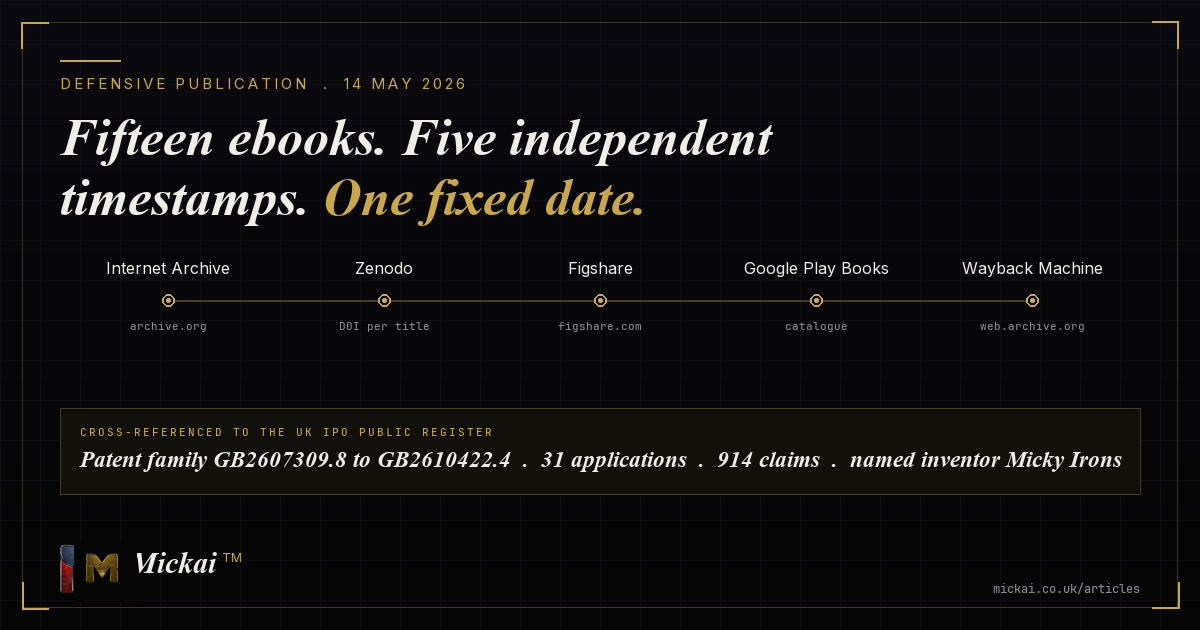
A defensive publication fixes the public engineering record under a date that no single party can move. The fifteen-ebook Mickai engineering corpus is now lodged across the Internet Archive, Zenodo with assigned DOIs, Figshare, Google Play Books, and the Wayback Machine. Each is an independent timestamp authority. The corpus is the readable engineering description of the substrate primitives whose full specifications sit in the UK IPO patent family GB2607309.8 to GB2611702.8 and GB2611885.1 onwards. The disclosure is its own audit chain: any party can verify the date offline, against five repositories, with no reference back to Mickai.
The corpus is now on a record no single party can move
The Mickai engineering ebook corpus is fifteen titles. It describes the substrate underneath a Sovereign Intelligence Operating System: the audit primitive, the post-quantum signing discipline, the trust-domain externalisation pattern, the twenty-five-brain orchestration, the hybrid browse sandbox, the procurement rubric for UK regulated buyers, and the engineering posture that ties them together. As of 14 May 2026 the full corpus is lodged on five independent public repositories: the Internet Archive, Zenodo (with a Digital Object Identifier minted per title), Figshare, Google Play Books, and the Wayback Machine capturing the canonical pages on mickai.co.uk. Each of those five is operated by a different organisation, on different infrastructure, under a different governance model. None of them coordinates with the others, and none of them coordinates with Mickai. The effect is that the corpus now carries a publication date that no single party, including Mickai, can revise after the fact.
That property is the point of this article. The corpus has always been readable. What changed on 14 May 2026 is that the date became fixed and independently verifiable.
What a defensive publication establishes
Defensive publication is a long-standing position in intellectual property practice. The mechanism is simple. When the full description of an invention is published under a fixed public date, two things follow. The description becomes prior art, which means it sits in the body of public knowledge that any later application is examined against. And the conception record is fixed, which means the date the substrate was described in public is on the record and can be cited. A defensive publication is constructive rather than adversarial. It does not assert a monopoly. It places a complete, dated, public description of the engineering into the commons, where it can be read, cited, and built against.
For a substrate, defensive publication is a particularly good fit. A substrate is meant to be adopted widely. The fifteen-ebook corpus describes primitives that a UK regulated buyer, a managed service provider, or another engineering team can implement against. Publishing the full description under a fixed date makes the substrate legible to all of those parties at once, and fixes the date at which it was made legible.
Why five independent repositories and not one
A single repository is a single point of trust for the date. If a corpus sits only on one platform, the date it carries is only as durable as that one platform's record-keeping, its governance, and its continued existence. Five independent repositories remove that single point of trust. The disclosure date is corroborated across five organisations that do not coordinate, each of which timestamps independently.
- Internet Archive. A public, non-profit digital library. Each title has its own archive.org item page with the full metadata and the PDF, crawled and indexed independently. The item page carries the upload date.
- Zenodo. Operated on infrastructure run by CERN. Each of the fifteen titles has a Digital Object Identifier minted on deposit. A DOI is a persistent, citable identifier with a registration date held by an external registration agency, which makes the Zenodo timestamp independently checkable through the DOI system itself.
- Figshare. A research-output repository operated by Digital Science. Each title is a published article record with its own identifier and deposit date.
- Google Play Books. The corpus is also lodged in Google's books catalogue, which carries its own catalogue date and is indexed into Google's search and books surfaces.
- Wayback Machine. The Internet Archive's web-capture service holds dated snapshots of the canonical mickai.co.uk pages, including the ebooks index. A Wayback snapshot is a third-party capture of the live web at a fixed moment, which fixes the date the corpus was publicly available at its own canonical URL.
The five together form a lattice. Any party that wants to check when the substrate corpus was disclosed can pull the date from any of the five, and cross-check it against the other four, without contacting Mickai. That is the structural property defensive publication is supposed to deliver, and it is delivered here by spreading the record across parties that have no reason to coordinate.
How the corpus maps to the UK IPO patent family
The fifteen ebooks are the readable engineering description of the substrate. The UK Intellectual Property Office patent family at numbers GB2607309.8 to GB2611702.8 and GB2611885.1 onwards is the formal filing of the same substrate. That family is 104 applications covering 2,340 claims, named inventor Mickarle Wagstaff-Irons, on the UK IPO public register. Each filing contains the full specification, the claims, the abstract, the prior-art search, the figures, and the Form-1 metadata. The ebook corpus and the patent family are two views of one substrate. The patent family is the formal specification, examined by the UK IPO. The ebook corpus is the public engineering description, now dated across five independent repositories. A reader who wants the formal claims goes to the public register. A reader who wants the engineering walkthrough goes to the corpus. Both are dated, both are public, and they describe the same primitives.
Holding both is deliberate. The patent family fixes the formal record at the UK IPO. The defensive publication fixes the engineering description in the wider commons. Between them, the substrate is on the record at the institutional level and at the public level, under dates that are independently verifiable in both places.
The disclosure is its own audit chain
There is a recursion here worth naming. The thesis of the Mickai substrate is that an audit chain should be verifiable offline, by any party, independent of the vendor that produced it. The chain is signed under the operator's key, in an open canonical format, and a third party can replay it without contacting the vendor. The defensive publication applies that exact thesis to the intellectual-property record itself. The disclosure date of the substrate corpus is verifiable offline, by any party, against five independent repositories, with no reference back to Mickai. The corpus is its own audit chain. The same structural move the substrate makes for a regulated buyer's evidence trail, the defensive publication makes for the substrate's own provenance.
This is not a rhetorical flourish. It is the same engineering principle applied at a different layer. A record that depends on one party to vouch for it is weaker than a record that any party can check. That is true for an AI audit ledger, and it is true for an intellectual-property disclosure.
What this means for the UK regulated buyer
A procurement officer or an engineering CTO in a UK regulated sector (defence-nuclear, civil-nuclear, finance, pharma, energy, water, telecoms, transport) evaluating sovereign AI can now read the full substrate description from five independent public sources. They can confirm the corpus was published under a fixed date. They can hold that as part of supplier due diligence. The substrate is not a private claim made in a sales conversation. It is a complete, dated, public engineering description, cross-referenced to a filed UK IPO patent family on the public register. A buyer does not have to take the description on trust. The buyer can pull it from the Internet Archive, from Zenodo against a DOI, from Figshare, from Google Play Books, and from the Wayback Machine, and verify the date in five places.
What this means for other British inventors
Defensive publication across independent timestamped repositories is a low-cost, high-durability intellectual-property posture, and it is available to any inventor. The repositories used here are free to deposit into. The Internet Archive, Zenodo, Figshare, and the Wayback Machine all accept open deposits with an account and no fee. The discipline is in the preparation: a complete engineering description, consistent metadata, and a deposit run that is itself recorded so the deposit can be re-checked. A British inventor with a described invention and the discipline to write it up fully can fix a public, independently verifiable disclosure date the same way. This article is a worked example. The fifteen-ebook corpus, the five repositories, and the cross-referenced UK IPO patent family are all on the public record and can be inspected as a template.
Engineering teams, procurement officers, and inventors who want a fifteen-minute walkthrough of the substrate, the corpus, or the defensive-publication run are welcome to write to press@mickai.co.uk. The fifteen ebooks are free at mickai.co.uk/ebooks and on each of the five repositories named above.
Sources and references
- Mickai engineering ebook corpus, fifteen titles, free at mickai.co.uk/ebooks.
- Internet Archive, public deposit of the corpus: archive.org, items prefixed mickai-.
- Zenodo, public deposit of the corpus with a minted DOI per title: zenodo.org.
- Figshare, public deposit of the corpus: figshare.com.
- Google Play Books, catalogue listing of the corpus.
- Wayback Machine, dated snapshots of mickai.co.uk and mickai.co.uk/ebooks: web.archive.org.
- UK IPO patent family GB2607309.8 to GB2611702.8 and GB2611885.1 onwards, 104 applications, 2,340 claims, named inventor Mickarle Wagstaff-Irons, on the public register.
- Mickai trade mark UK00004373277, classes 9 and 42, filed 15 April 2026.
- Defensive publication as an intellectual-property mechanism: the publication of a full invention description under a fixed public date to establish prior art and fix the conception record.