The Sovereign Trading Workstation
Twenty agents, one cooperative substrate, signed under the operator's key. What the next generation of trading systems looks like, and why the hardware floor still keeps it out of reach for most.
The latency problem in modern trading is not bandwidth. Gigabit fibre is widely available and most prosumer trading desks already have it. The latency that costs trades is the round trip to a shared model provider.
A typical decision cycle on a cloud-hosted LLM trading agent works like this. Market data arrives at the operator's machine in single-digit milliseconds via the broker's WebSocket. The agent serialises the relevant context, sends it to a hosted LLM API, waits for the response, parses, and routes the order. End to end the round trip sits between two hundred and five hundred milliseconds. On a Polymarket binary that moves through its spread in fifty milliseconds, the decision is post-execution. On equities the agent is trading the previous tick.
The shared inference layer adds a second tax. A hosted endpoint runs the same model against a thousand other tenants. Tail latency spikes are common. Throughput is throttled at the provider's quota tier. Privacy across tenants is contractual rather than architectural.
The Mickai substrate answer is to run a frontier-class model locally, on the same workstation that hosts the order router, on the operator's own gigabit fibre. Inference and execution share a memory space. Decision-to-order becomes a function call instead of a network round trip. The latency drops below fifty milliseconds for a single-agent decision. For a twenty-agent ensemble debating in parallel, it stays within the window of a single market tick on most venues.
The hardware floor
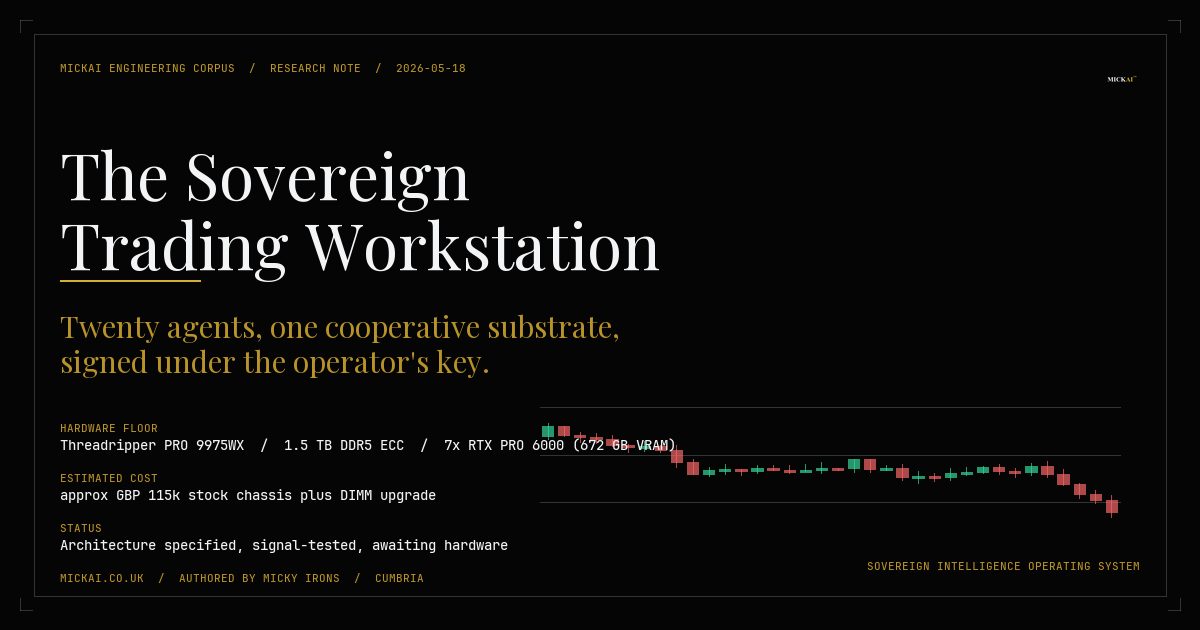
This shape of system has a serious hardware floor. The reference chassis is the Scan 3XS Development Box Pro B7-64TR Fluid: an AMD Ryzen Threadripper PRO 9975WX (32-core, 64-thread, 5.4 GHz boost), 512 GB of DDR5 ECC RDIMM memory, and seven NVIDIA RTX PRO 6000 cards at 96 GB GDDR7 each for 672 GB of aggregate VRAM. The price is just under one hundred thousand pounds.
For the Mickai Trading subsystem the ideal configuration adds memory. The ASUS PRO WS WRX90E-SAGE SE motherboard supports up to 2 TB of DDR5 ECC across eight DIMM slots. With eight 192 GB modules the system reaches 1.5 TB. The uplift is roughly fifteen to twenty thousand pounds in memory parts, taking the total to around one hundred and fifteen thousand pounds. The extra memory is not for the LLM weights, which live in VRAM. It is for the concurrent agent contexts, the rolling tape buffers, the KV cache spillover during long-running positions, and the historical replay buffer for the OAR audit chain.
This is structurally out of reach for individual retail traders. It is within reach for a serious proprietary desk, a quantitative fund, or a well-capitalised sovereign operator.
The twenty-agent ensemble
The Mickai Trading subsystem runs twenty specialised agents. Each is named for a documented trader or fund and is trained on the publicly available record of that operator's methodology. The agents are not impersonations. They are signal generators that embody the documented strategy of their namesake, operating against a separate Mickai brain primitive on the cooperative architecture.
Ensemble command
- BUFFETT. Capital allocation oversight and holding-period veto.
- MUNGER. Risk veto and mental-models cross-check.
- LYNCH. Bottom-up screening and fundamental sanity.
Quant and systematic
- SIMONS. Statistical arbitrage and signal generation.
- THORP. Probability-weighted sizing under Kelly criterion.
- MANDELBROT. Fractal volatility analysis and tail estimation.
- RENAISSANCE. Proprietary machine-learning ensemble across the agent outputs.
Macro
- SOROS. Reflexivity detection and macro positioning.
- DRUCKENMILLER. Macro position sizing.
- DALIO. Risk parity and all-weather allocation.
- KOVNER. Sovereign and currency macro.
- TUDOR. Macro risk management.
Trend and systems
- SEYKOTA. Trend following.
- DENNIS. Breakout systems, descended from the Turtle methodology.
- COVEL. Trend evaluation and persistence scoring.
Momentum
- MINERVINI. Momentum under the SEPA framework.
- ONEIL. Growth screening under the CANSLIM framework.
- LIVERMORE. Tape reading and breakout confirmation.
Tactical and tail risk
- STEINHARDT. Short-term tactical positioning.
- TALEB. Convexity exposure and black-swan hedging.
The cooperative architecture
Each agent generates signals against its specialty. The Arbiter brain, an existing Mickai SIOS primitive, routes a given instrument to the agents whose methodologies match the venue, the timeframe, and the underlying. The Aggregator brain weights the signals by each agent's recent calibration record. The Risk Brain enforces position limits, drawdown caps, and the operator's signed risk constitution. Every decision, every signal, every override is recorded in the Open Audit Record. The OAR primitive is filed at the UK IPO public register as GB2610413.3 and is the same audit substrate that underpins the broader Mickai SIOS.
What we have tested
On 2026-05-17 the substrate ran a perfect-foresight oracle backtest across every Polymarket binary market that resolved in the preceding eighteen hours. With a starting capital of ten thousand pounds and a realistic liquidity cap on each cycle, the backtest returned 17.19x. The unconstrained mathematical upper bound was higher by orders of magnitude, bounded by real-world market depth that the realistic cascade respects. The full report, signed under SHA3-512, is published at mickai.co.uk/research/polymarket-oracle-backtest-2026-05-17.pdf. Every cycle is reproducible by re-querying Polymarket's public CLOB price-history endpoint at the asset id and timestamp shown in the report.
Why hardware is the gating step
Each agent's inference is a few hundred milliseconds against the local Mickai-class model. Twenty agents debating in parallel against the same workstation finish within the window of a single market tick on most venues. Routing the same ensemble through a cloud LLM provider would stack the round trips serially or saturate a quota tier, pushing the decision-to-order latency from sub-fifty milliseconds into the multi-second range. On binary venues like Polymarket where spread closure happens in fifty to two hundred milliseconds, this is the difference between trading the move and trading the post-move price.
What this means for the future of trading
Trading firms at the top end have operated this way since the inception of electronic markets. Renaissance, Citadel, Jane Street and the rest of the systematic majors all run inference on their own silicon, on their own fibre, against their own audit logs. What changes now is reach. The hardware to do this credibly used to start at ten million pounds. It now starts at one hundred thousand. The model is one the operator controls rather than vendor-licensed. The audit log is signed under the operator's own post-quantum ML-DSA-65 key rather than a prime broker's logbook. The architecture that previously belonged to the institutional desk is now available to any sufficiently capitalised independent operator.
A note on what we have not done
This article describes a system that is specified, signal-tested in oracle backtest, and architected against the Mickai SIOS. Live capital has not been deployed. Live trading performance will look different from the backtest in ways that matter: signal latency, partial fills, slippage, exchange feed gaps, and the long tail of real-world execution friction. The architecture is being published before live performance is verified so the community can validate the design independently. Live results will be published when they exist, signed into the OAR chain at the time of execution.
Status
The Mickai Trading subsystem architecture is built and signal-tested. Production deployment is gated on the workstation upgrade described above. The next funding cycle places the hardware on the schedule. When the chassis is in place, live operation begins. Updates will be published as the system moves into production, with every state change recorded in the audit log under the operator's signed key.
Author
Micky Irons, founder and named inventor of Mickai. Based in Cumbria. UK IPO public register GB2607309.8 to GB2611702.8 and GB2611885.1 onwards. Mickai LTD trade mark UK00004373277.